The End of Anonymous Freelancing: Why Verified Student Talent Wins in 2026
TL;DR
AI, EU regulation, and GDPR are killing anonymous gig work. Discover why verified, accountable student talent is the only model that works in 2026.
For more than a decade, freelancing sold a simple promise: cheap and fast. Post a task, pick the lowest bid or the highest star rating, and get something usable by morning. You rarely knew who actually did the work. You rarely needed to. The output was "good enough," and the price was hard to argue with.
In 2026, that promise is quietly falling apart — and not because freelancing is dying. It's because the thing that made anonymous, commodity freelancing work has been automated away. Three forces are converging this year: artificial intelligence is flooding the generic platforms, a major EU directive is rewriting the rules of platform work, and GDPR enforcement has reached a scale no business can wave away. Together, they point to one conclusion. The future of freelancing isn't cheaper or faster. It's verified, accountable, and secure.
1. AI broke the "cheap and fast" model — on purpose
The first crack is the most visible. Generative AI can now produce a logo, a blog post, a basic data-entry pass, or a simple ad in seconds, at almost no marginal cost. These are exactly the categories that built the big generic marketplaces. Predictably, prices for them are collapsing, and downloads of the largest platforms have declined two years running as the commodity floor falls out.
But the same wave is creating a counter-trend that tells the real story. In February 2026, Upwork reported that demand for AI-related freelance skills grew 109% year-over-year, with AI video generation and editing surging 329% to become its fastest-growing category. Across the market, 77% of freelancers now use AI tools in their work, and the productivity gap between those who do and those who don't is widening fast.
Read those two trends together, and the picture is clear: the market is splitting in two. At the bottom, anything a machine can do alone is racing toward zero. At the top, demand is climbing for people who can direct the machine, judge the output, and stand behind the result. When anyone can generate something passable, the scarce, valuable thing is no longer the output. It's trust — knowing who did the work, that they're real, and that someone is accountable if it goes wrong. Anonymous freelancing has no answer to that. Verified freelancing is built for it.
2. Regulation is rewriting platform work — and it rewards transparency
The second force is legal. The EU Platform Work Directive must be transposed into national law across member states by 2 December 2026, and Germany is expected to implement it strictly. Its provisions are aimed squarely at the opaque, algorithm-driven model that defined the first generation of gig platforms.
The directive introduces a legal presumption of employment for platform workers, shifting the burden of proof onto the platform to show exists. It restricts algorithmic management — banning the processing of certain categories of worker data and requiring human review of consequential decisions like account suspension, payment disputes, or termination. In short, it punishes platforms that hide behind a black box and treat workers as anonymous, interchangeable inputs.
For platforms built on opacity, this is an existential headache. For a platform built on verification and transparency, it's a tailwind. A model where every student is identity-verified, every project is governed by clear terms, and decisions are made by people rather than an unaccountable algorithm doesn't need to scramble to comply — it's already pointed in the direction the law is travelling. Add Germany's decision to raise the international-student work cap to 140 days for 2026, and the regulatory environment is actively widening the supply of legally enabled student talent at the same moment it's squeezing the old gig model.
3. GDPR turned "we trust them" into a liability
The third force is the one most SMEs underestimate until it's too late: data. The moment you hand a freelancer a customer list, a login, or a folder of project files, you've shared personal data — and under GDPR, the liability is yours, not theirs.
The numbers have stopped being abstract. Cumulative GDPR fines have now passed €7.1 billion, with more than 2,800 issued, and penalties can reach €20 million or 4% of global revenue. German data-protection authorities in Berlin, Bavaria, and North Rhine-Westphalia have been running systematic industry audits since 2024 — without waiting for a complaint. Yet most SME–freelancer collaboration still runs on the riskiest possible plumbing: customer data emailed as spreadsheets, files parked in someone's personal Drive, credentials shared over chat.
"We trust them" is not a data-protection strategy, and in 2026 it's an expensive gamble. This is precisely why where the work happens matters as much as who does it. A secure-by-design workspace — where client data stays inside a controlled environment rather than scattering across personal inboxes and devices — turns GDPR from a recurring anxiety into a baked-in feature. Security stops being a checkbox and becomes the product.
Where WURP fits
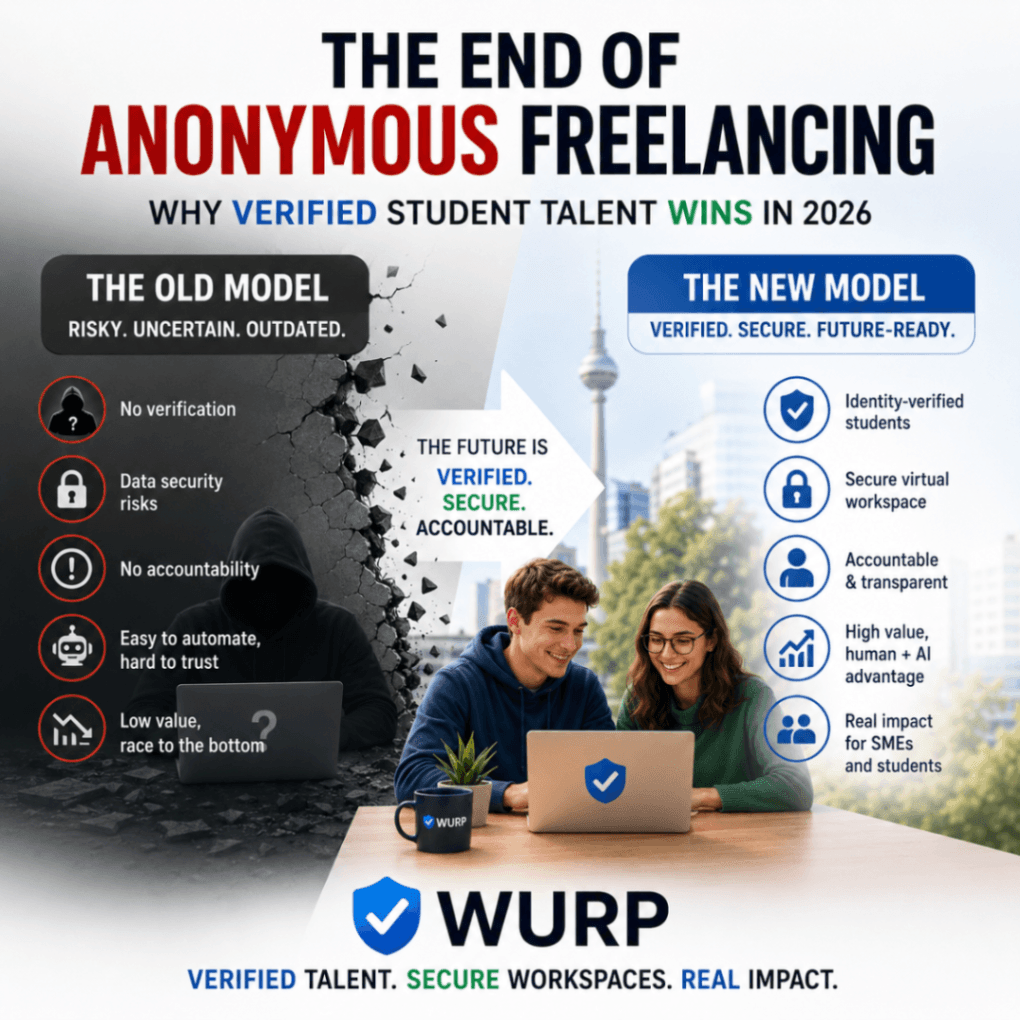
These three shifts rhyme. AI is making trust a scarce asset. Regulation is rewarding transparency. GDPR is making security non-negotiable. Each one, on its own, chips away at the anonymous gig model. Together, they describe the platform that comes next — and that's the platform WURP was built to be.
WURP connects verified university students across Germany and the EU with SME clients for real projects inside a secure virtual workspace. Every student is identity-verified, so clients know exactly who they're working with. Every project runs inside a controlled environment, so customer data never has to leave the platform for a personal device. And the model is transparent by design, so it moves with the direction the regulation is heading, not against it.
For SMEs, that means closing the digital skills gap — Germany alone has around 149,000 unfilled IT roles — with talent you can actually trust and data you can actually protect. For students, it means real-world work that's verified, fairly governed, and built for the way the EU now expects platform work to operate.
The era of cheap, anonymous, unregulated freelancing is ending. What replaces it is verified, secure, and accountable. That's not a constraint to work around in 2026 — it's the whole opportunity.
Ready to work the way 2026 demands? → www.wurp.io
SelfEmployed – AI and Freelance Platforms in 2026
Upwork – Gig Economy Statistics and Freelance Trends
Council of the European Union (Consilium) – Platform Work in the EU
Ogletree Deakins – The EU Platform Work Directive Explained
Kiteworks – GDPR Fines and Data Privacy Enforcement 2026
Worksuite – GDPR Compliance When Working with Freelancers
Digital Chiefs – SME Digitalization 2026: Status Report
HRStacks – Gig Economy and Freelance Work Statistics